
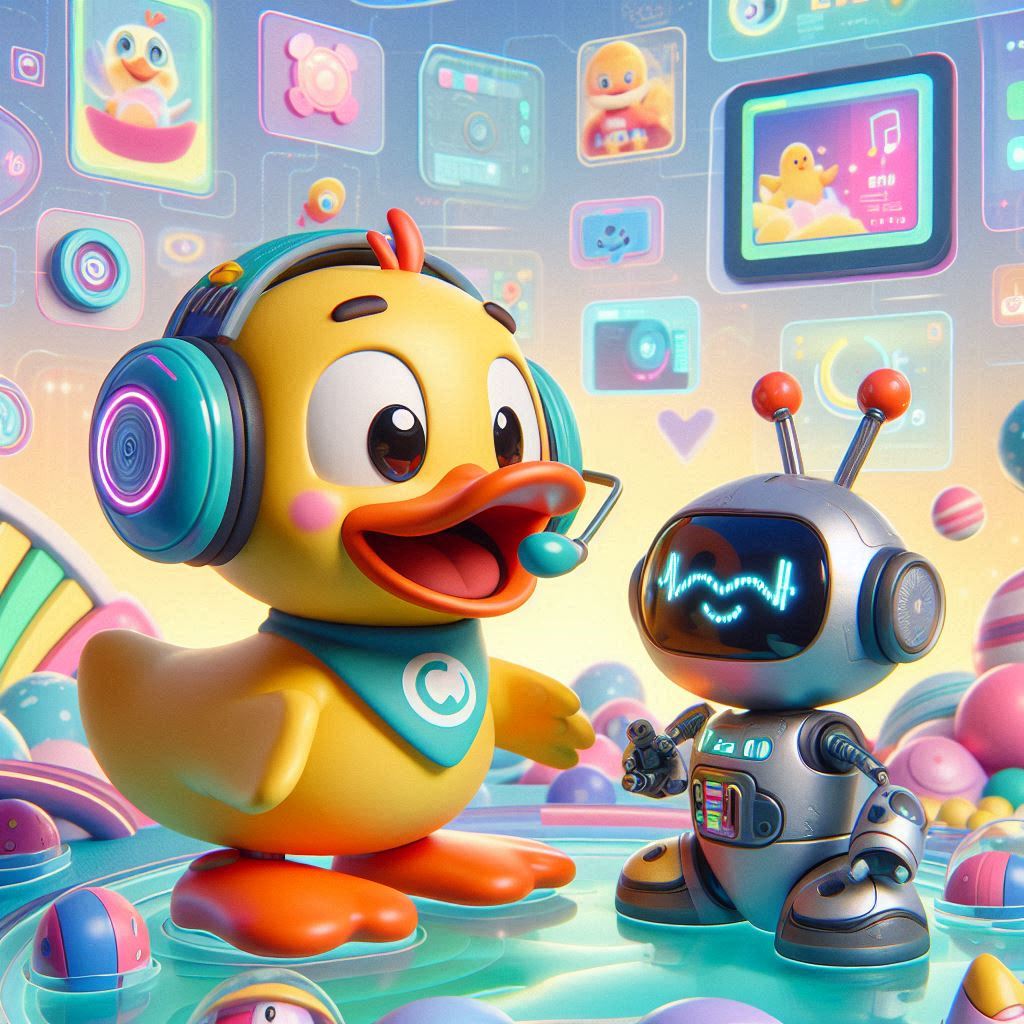
The age of AI-driven blockchain
Artificial intelligence and blockchain used to exist in separate worlds: one focused on smart algorithms, the other on immutable transparency. Quack AI Governance bridges those two realities. It introduces a self-learning governance framework that can adapt, reason, and refine decisions across decentralized networks – without compromising trust.
Quack AI, a project developed under the CMC AI ecosystem, isn’t just another analytics tool. It’s a governance intelligence layer built for communities, DAOs, and blockchain protocols that need efficient, data-driven decision-making. Where traditional governance relies on human votes or static smart contracts, Quack AI Governance uses cognitive AI models to interpret intent, predict outcomes, and optimize the rules themselves.
In simple terms: it’s governance that learns.
What exactly is Quack AI?
According to official materials on CoinMarketCap’s AI portal, Quack AI is designed to bring “machine reasoning to decentralized consensus.” That means it doesn’t replace human decision-makers – it helps them.
Here’s the core idea:
- The Quack AI network collects on-chain and off-chain data (like proposals, votes, and market indicators).
- Its AI layer evaluates the sentiment, risk, and potential outcomes of each decision.
- The governance engine recommends the most rational course of action while remaining transparent and verifiable on-chain.
That’s the kind of tool DeFi and Web3 have needed for years: something that understands nuance but remains incorruptible.
The problem it aims to solve
Most decentralized projects face the same paradox: the more users they attract, the harder it becomes to make decisions efficiently. Voting mechanisms become slow, participation drops, and proposals get buried in bureaucracy.
Quack AI Governance tackles that by introducing adaptive governance intelligence (AGI) – not the sci-fi kind of AGI, but an algorithmic model that evolves based on community behavior.
Imagine a DAO that knows when a proposal is likely to fail due to poor communication, or an NFT project that can forecast community backlash before a policy is even voted on. That’s the kind of predictive insight Quack AI offers.
Governance in the Quack AI ecosystem
The governance model behind Quack AI is layered into three dynamic components:
| Layer | Function | Description |
|---|---|---|
| Core Governance Model | Foundation | Rules encoded in smart contracts controlling key functions like staking, voting, and treasury management. |
| AI Advisory Layer | Intelligence | Machine-learning models analyzing data and predicting the impact of proposals. |
| Community Oversight | Human element | The transparent layer where users validate, override, or refine AI recommendations through voting. |
This tri-layered design keeps the system balanced – efficient but not authoritarian, autonomous yet still community-driven.
Why governance matters in AI projects
AI without governance is just automation; blockchain without governance is chaos. Quack AI Governance sits right in between – ensuring that automated decisions remain accountable.
It introduces something that’s been missing from Web3: explainable AI within a decentralized structure. Every recommendation the algorithm makes is logged, traceable, and auditable. Users can see why a model leaned toward a certain outcome. That’s crucial for maintaining transparency in an environment where code, not people, makes most decisions.
The technology behind the idea
The technical architecture of Quack AI relies on:
- Neural reasoning engines trained on governance data.
- Natural-language processing to interpret proposals in human terms.
- Blockchain-anchored transparency that records all AI actions on-chain.
- Tokenized incentives that reward participation and data contribution.
Each part contributes to a simple but powerful outcome: smarter decentralized systems that grow through learning, not through centralized oversight.
Why the “Quack”?
It might sound playful, but the branding serves a purpose. Quack AI’s founders emphasize accessibility – governance shouldn’t be intimidating. The name captures the project’s mix of innovation and relatability: intelligent, but not elitist.
Behind the lighthearted name hides a serious ambition: to make AI governance open-source, auditable, and community-owned.
Early use cases and adoption
In early 2025, Quack AI began collaborating with several DeFi platforms and DAO infrastructures to test its governance modules. Among them:
- Liquidity management DAOs, where AI evaluates when to adjust yields.
- NFT collectives, using predictive models to detect manipulation in voting.
- Gaming ecosystems, integrating adaptive AI voting for community-driven updates.
These pilots demonstrated measurable improvements in participation rates and proposal quality.
One DAO reported a 43% reduction in rejected proposals after introducing Quack AI’s pre-vote analytics – proving that smarter governance isn’t just theoretical.
The rise of governance tokens and AI synergy
In the world of blockchain, governance tokens have become a standard mechanism for distributing power. But power without intelligence often leads to inefficiency. That’s where Quack AI Governance becomes a meta-layer: it doesn’t change who votes – it changes how decisions evolve.
Through AI analysis of proposal outcomes, Quack AI can recommend adjustments to tokenomics, helping ecosystems stay balanced. Imagine a governance token that learns to optimize its own distribution policies – that’s the ultimate promise here.
Transparency and accountability
Critics of AI in governance often point to one fear: “black box” decision-making.
Quack AI’s response? Make every decision explainable and verifiable.
All AI-generated recommendations are stored on-chain with contextual metadata – meaning anyone can review how a conclusion was reached. The result is a hybrid model of trust through verifiable computation, where transparency replaces blind faith.
A glimpse into the future
If this system scales, Quack AI Governance could redefine how decentralized ecosystems evolve. Instead of chaotic votes and endless debates, we might see intelligent consensus – guided by data but validated by people.
That balance between algorithmic logic and human intuition could finally solve one of Web3’s oldest problems: how to grow without losing democracy.
Quack AI Governance – The Intelligent Core of Decentralized Consensus
Beyond automation: governance that adapts
Most blockchain projects automate decisions. Few actually learn from them. That’s where Quack AI Governance steps in — not as a centralized overseer, but as an evolving intelligence that listens, predicts, and refines itself based on outcomes.
The system doesn’t just tally votes; it interprets their meaning. When participants reject a proposal, the AI studies why. When support surges unexpectedly, it maps the emotional and economic context behind it. Over time, the governance engine becomes a living neural network for community behavior.
That’s the future Quack AI is quietly building: a governance model that grows smarter with every cycle.
The architecture of intelligence
Quack AI’s core design connects three technological layers, each reinforcing the other:
| Layer | Core Function | Purpose |
|---|---|---|
| Data Layer | Collects real-time blockchain and off-chain data | Ensures the AI has a holistic view of governance activity |
| AI Processing Layer | Uses natural-language reasoning and predictive analytics | Interprets proposals, predicts risks, and suggests optimal outcomes |
| Blockchain Layer | Executes verified governance decisions on-chain | Guarantees transparency and immutability |
This tri-architecture keeps governance decentralized but guided. Every insight Quack AI generates is logged, timestamped, and verifiable through cryptographic proofs.
The beauty of it lies in what it doesn’t do — it doesn’t replace human input. It simply ensures that every human decision is informed by deep, unbiased intelligence.
Governance tokens reimagined
The concept of governance tokens isn’t new, but Quack AI takes it to another level. Instead of representing static voting rights, tokens here serve as dynamic governance credentials.
The more responsibly a holder participates — reading proposals, engaging in debate, or validating AI analyses — the more influence their token accrues. In contrast, inactive holders gradually lose priority weight.
It’s governance as reputation, not speculation.
This approach solves a major flaw in many DAOs: voting apathy. Quack AI’s system motivates users to participate continuously, making governance a daily process rather than an occasional event.
The economics of intelligent participation
The Quack AI ecosystem uses an incentive model that blends traditional staking logic with AI metrics. Rewards aren’t just given for locking tokens; they’re distributed for contributing meaningful data to governance intelligence.
Key incentive metrics:
-
Proposal quality score (AI-evaluated based on clarity and impact).
-
Voting consistency (tracking participation rates).
-
Feedback contribution (community validation of AI suggestions).
-
Reputation growth (earned through sustained engagement).
This turns governance into an economic game — one where wisdom pays.
Imagine a future where your knowledge, reasoning, and constructive feedback generate on-chain rewards. That’s the essence of Quack AI’s governance economy.
Integration with blockchain protocols
Quack AI was designed as a modular layer — meaning it can integrate with different blockchains and DAOs without rebuilding their infrastructure.
Its governance engine uses smart API bridges that communicate with various consensus mechanisms, from Proof of Stake (PoS) to Delegated Proof of Authority (DPoA).
That flexibility makes it compatible with ecosystems such as:
-
Ethereum – via governance APIs and oracles.
-
BNB Chain – through adaptive staking protocols.
-
Polygon – for fast data verification.
-
Avalanche – using AI-optimized subnet management.
This cross-chain functionality gives Quack AI Governance a rare superpower — it’s not tied to a single network. Instead, it becomes the connective tissue between decentralized ecosystems.
Community-driven evolution
Quack AI’s developers emphasize one principle: intelligence must remain accountable to the community. That’s why the system includes periodic “Governance Review Epochs”, where AI decisions and weightings are openly debated.
During these epochs, users can:
-
Audit AI reasoning logs.
-
Vote to adjust algorithmic thresholds.
-
Propose training data updates for the AI models.
This ensures the technology evolves hand-in-hand with human oversight. The process might sound technical, but it’s essentially democratic — a new kind of machine democracy where consensus feeds cognition.
Comparison with other AI governance frameworks
Quack AI isn’t the first attempt at merging artificial intelligence and blockchain governance, but its approach is arguably the most community-centric.
| Project | Core Focus | Weakness | What Makes Quack AI Different |
|---|---|---|---|
| SingularityNET | AI marketplace | Not governance-oriented | Quack AI focuses specifically on decision-making transparency |
| Fetch.ai | Smart economic agents | Limited DAO integration | Quack AI embeds governance AI directly into blockchain logic |
| Numerai | Decentralized prediction markets | Closed data ecosystem | Quack AI is open-source and interoperable |
| Quack AI | Governance intelligence | — | Combines adaptive AI reasoning with on-chain transparency |
Unlike others, Quack AI doesn’t just optimize transactions — it optimizes trust.
Ethics, bias, and explainability
When artificial intelligence enters the governance domain, ethics become non-negotiable. Quack AI’s framework includes several mechanisms to prevent bias or algorithmic manipulation:
-
Explainable AI (XAI) – every decision comes with a readable explanation.
-
Community audits – random users are rewarded for reviewing AI outputs.
-
Bias detection modules – monitor voting trends to prevent echo chambers.
-
Immutable evidence logs – every AI recommendation is permanently stored on-chain.
The result is a governance model that is not only intelligent but also accountable — something very few AI-driven systems can claim.
The human factor: augmented democracy
One of the most profound effects of Quack AI Governance is psychological. For years, decentralization was about removing intermediaries. Now it’s about enhancing collective intelligence.
When users realize that their voices are supported — not replaced — by machine reasoning, engagement rises. This creates what some experts call augmented democracy: a system where the crowd and the code coexist.
Quack AI doesn’t aim to outsmart people. It aims to amplify them.
Why investors and analysts are paying attention
In 2025, the intersection of AI and Web3 became one of the fastest-growing segments in crypto. According to CoinMarketCap’s AI analytics section, projects that integrate governance intelligence gained over 180% in average market capitalization growth year over year.
Quack AI sits near the center of that movement. Analysts see it as a potential infrastructure protocol rather than just a single use case — something that could be licensed, forked, or embedded into hundreds of decentralized applications.
Its potential lies not in hype, but in architecture: a system where governance, intelligence, and economics finally work together.
Transparency as the foundation of trust
Every blockchain project talks about transparency, but few deliver it on the algorithmic level.
Quack AI’s solution — storing reasoning steps and AI inference metadata directly on-chain — ensures that no decision is “black box.”
For regulators, this opens a path toward compliant AI governance. For users, it restores the one thing DeFi lost in its race for innovation: trust.
As one early community member wrote on the Quack AI forum:
“For the first time, I can see why an AI made a suggestion — and that changes everything.”
Quack AI Governance – Building the Future of Digital Trust
The long-term vision
Quack AI isn’t a short-lived trend; it’s an architectural movement toward smarter self-regulation. Its creators see governance as a living organism – one that constantly evolves through data, participation, and collective learning.
The ultimate goal?
To create a self-improving governance layer for all decentralized ecosystems – where every proposal, every decision, every disagreement becomes fuel for the next stage of intelligence.
This approach is not about replacing traditional governance but amplifying it with algorithmic clarity.
In the same way that blockchain gave us verifiable transactions, Quack AI Governance gives us verifiable decisions.
The 2025-2030 roadmap
According to the CMC AI development outline, Quack AI is currently transitioning from its beta analytics phase into a governance infrastructure stage. Here’s how its evolution is projected to unfold:
| Year | Stage | Milestone |
|---|---|---|
| 2025 | Foundation | Launch of governance AI beta modules integrated with DAO partners |
| 2026 | Expansion | Introduction of multi-chain governance compatibility and token utility incentives |
| 2027 | Transparency Layer | Rollout of on-chain Explainable AI dashboard for real-time audits |
| 2028 | Autonomy | Deployment of adaptive self-regulation – governance that self-corrects |
| 2029-2030 | Global Integration | Partnerships with DeFi, NFT, and metaverse ecosystems; cross-protocol AI voting modules |
The vision culminates in a decentralized framework that acts as the “brain of Web3” – intelligent, fair, and impossible to manipulate.
Decentralized intelligence meets human intuition
The biggest question people ask is: Can AI truly understand human values?
Quack AI’s team believes it can – but only if trained by the right data: transparent, diverse, and ethically sourced community input.
To achieve this, Quack AI Governance applies value alignment algorithms that weigh emotional sentiment alongside technical logic.
For instance, when analyzing a proposal about protocol fees, the AI not only considers tokenomics but also community sentiment metrics. It recognizes that governance isn’t just about math – it’s about meaning.
This emotional calibration might be what sets Quack AI apart from every other project in the blockchain-AI field.
Intelligent governance in real-world systems
While the initial focus is blockchain, the Quack AI Governance framework could extend far beyond crypto. Imagine municipalities, corporations, or even NGOs adopting similar models of transparent algorithmic decision-making.
A few examples currently under exploration:
- Sustainability governance: allocating environmental funds based on AI-verified impact data.
- Corporate DAOs: allowing shareholders to vote with enhanced AI guidance.
- Education systems: decentralized grant distribution governed by data-driven ethics models.
If these use cases scale, Quack AI might become the bridge between Web3 governance and global civic technology – the start of digital democracy 2.0.
Philosophical implications – Who governs the governors?
AI governance inevitably raises philosophical tension. When algorithms suggest how humans should vote, who watches the algorithm?
Quack AI addresses this by enforcing meta-governance – the governance of governance itself. Every AI model used in the system undergoes community validation and performance reviews.
If a model’s bias is detected, it’s flagged, retrained, or replaced. The idea is simple but revolutionary: no machine should rule unchecked.
This self-regulatory loop mirrors human democracy – checks and balances, encoded in code.
It also brings a new layer of philosophical depth to blockchain: the realization that intelligence, when transparent, becomes a new kind of morality.
The role of transparency and education
One of Quack AI’s less-discussed but crucial goals is educating the next generation of blockchain citizens.
Every time an AI-generated decision appears on-chain, it comes with an explanation: context, reasoning, and potential risks. This transforms governance into a learning experience rather than a mechanical vote.
Over time, this could lead to more informed communities, capable of critical thinking and collaborative reasoning – exactly what Web3 promised but never fully achieved.
So, when people talk about rankings or performance charts in the AI governance ecosystem, the most important metric isn’t speed or profit – it’s understanding.
Cultural and social influence
Quack AI’s rise also carries cultural weight. It represents a shift from the “trustless” culture of blockchain toward a “trust-through-intelligence” paradigm.
Users are no longer passive participants or mere token holders – they become cognitive contributors to a digital organism that learns from them.
And there’s something almost poetic about that.
A protocol named Quack – humorous, humble, and accessible – ends up pioneering one of the most complex ideas in the crypto sphere: collective intelligence.
It’s technology with personality – and that’s precisely why it’s resonating with developers, investors, and thinkers alike.
The ethics of digital sovereignty
As AI governance matures, questions of control and sovereignty become unavoidable. Who owns the data that trains the models? Who defines the ethical boundaries?
Quack AI’s answer lies in distributed ownership.
All governance data remains open-source and accessible. The models themselves are community-audited and upgradable through consensus. This ensures that no single entity – not even the developers – can monopolize decision-making.
The framework aligns with the core values of crypto: autonomy, verifiability, and shared power.
Forecasting the evolution of quack ai governance
Experts in the AI governance sector anticipate a three-stage progression for projects like Quack AI:
- Assistive Governance (2025-2026): AI acts as a guide, analyzing data and offering insights.
- Adaptive Governance (2027-2028): AI begins self-improving, refining decision-making models dynamically.
- Collective Intelligence Governance (2029+): AI and human reasoning merge into a unified, self-regulating ecosystem.
By 2030, Quack AI could be the foundation for how decentralized organizations, public networks, and even hybrid private entities make transparent, explainable decisions.
This evolution mirrors humanity’s broader trajectory – from manual coordination to intelligent cooperation.
Challenges ahead
Of course, the path isn’t without obstacles. Quack AI still faces several critical challenges:
- Regulatory uncertainty – global frameworks for AI governance are still evolving.
- Technical scalability – storing large AI models on-chain remains expensive.
- Cultural resistance – some communities fear “AI replacing human will.”
- Security risks – governance systems are potential targets for adversarial attacks.
But each of these challenges also represents an opportunity for refinement. The project’s transparency-first design gives it a unique advantage: every weakness becomes data for improvement.
That’s the beauty of learning systems – they grow stronger from feedback.
The bigger picture
Zoom out, and you’ll see that Quack AI Governance is not just another crypto innovation. It’s part of a broader cultural evolution toward accountability in intelligent systems.
We’re entering an era where algorithms are no longer hidden tools but visible participants in decision-making.
And Quack AI stands as one of the first projects to give those algorithms a moral compass – built not on authority, but on open collaboration.
A new definition of governance
So, what does governance mean in the age of Quack AI?
It’s not about control. It’s about coherence.
Governance becomes the art of aligning intelligence – human and artificial – around shared values.
And maybe that’s the quiet revolution hidden beneath all the data, models, and consensus layers: a reminder that technology can bring us closer to collective wisdom, not just efficiency.
Because in the end, governance isn’t about who leads – it’s about how we learn together.
Final thoughts
Quack AI Governance stands at the intersection of transparency, intelligence, and democracy.
It represents what many in Web3 have been searching for: a way to evolve systems without sacrificing trust.
If its roadmap succeeds, the next decade of decentralized governance won’t be ruled by code – it will be guided by it, intelligently, transparently, and collaboratively.
And that’s not just innovation. That’s progress.